Showing posts with label hawaii. Show all posts

05 August 2012

Picking fruit


"I pick fruit."

That's what I used to say when I was field botanizing for the National Tropical Botanical Garden and people'd ask what I did.  There are times I wonder why I left that job.

I did pick lots of fruit.  Collecting seed from native Hawaiian plants was one of the main responsibilities.  The Garden grows plants for projects attempting to restore native habitat all over Kauai and elsewhere in Hawaii.  Natalia Tangalin - who is still living the Field Botanist dream job - got stuck showing me the ropes.  We started with day trips (actually we started surveying weeds along the roadside in an old Ford Explorer with a leaky exhaust system - but that's another story) - collecting mostly up in the forest in Kokee state park or in the native coastal plant communities on the south shore and east side of the island.  But we soon began to dream of the Garden's hay days - back in the 80s and 90s when helicopter budgets were flush, before Hurricane Iniki leveled half of Kauai's native forest - when our colleagues and predecessor Field Botanists Steve Perlman and Ken Wood were getting dropped into the most remote parts of the island, finding new species, making the cover of National Geographic… Man, they got it good.

Yes - this is a National Geographic cover - plant in the mouth - nice touch Kenny!
Make no mistake - we had it good too.  The best part of collecting was that as long as we got the seeds the Garden needed, we could pretty much go wherever we wanted (permits permitting).  So we planned our field trips so that we could also re-locate and check up on some of the rarer plants out there.  Hawaii has got far too many plant species on the critically critically endangered list, far too many persistent threats - goats, pigs, and weeds - and far too few people keeping an eye out (thankfully there are PEPP folks and others).  We weren't really pining for the good ol' days - ok maybe a little bit - we just wanted to check out those same deep pockets and plants that Ken and Steve had been exploring for years.  And at some point it hit us that we could...we just had to do it on our own four feet.  Day trips were over - we started gearing up for overnighters.


wet road in Kokee and my favorite Garden ride

Our first real 'shake-down' was hilarious in retrospect.  In reality it was cold and wet wet wet - scary wet.  Winter time on Kauai and just the week before Steve got caught in a flash flood, yet another story but for someone else to tell.  As far as we were concerned we were playing it safe.  We took the Garden's Toyota pickup through Kokee State Park, past a couple little stream crossings to the end of Camp 10 road.  After a relatively short walk along the north rim of Koaie Canyon, Natalia found this hunter track she'd heard about and, with full packs, we dropped off the edge of the Alakai Plateau.  Less than a half mile long, the track dropped over 2,000 feet (about 600 m) - a radical shortcut that left us far in the back of the canyon.  Its a very cool vegetation zone - a high diversity of native plants due to the intermingling of the rainforest of the Alakai wilderness with the drier forest of Waimea Canyon - and home to a few scattered individuals of Alectryon macrococcus (Mahoe), a small Hawaiian tree that's critically endangered.


natalia films the decent

We set up camp across the river and explored downstream into the drier forest zone.  As the wet forest elements thinned along the banks, we poked into a couple smaller tributaries leading up to waterfalls below the occasional giant white hibiscus tree.  Looking west you could see the 'new' forest of invasive strawberry guavas marching up the sunnier, drier slopes of the canyon, while east towards the back, the darker, patchier canopy of native ohia-lehua trees held on.  No Aletryons that day.  We made it back to camp a bit before dusk and checked out our setup.
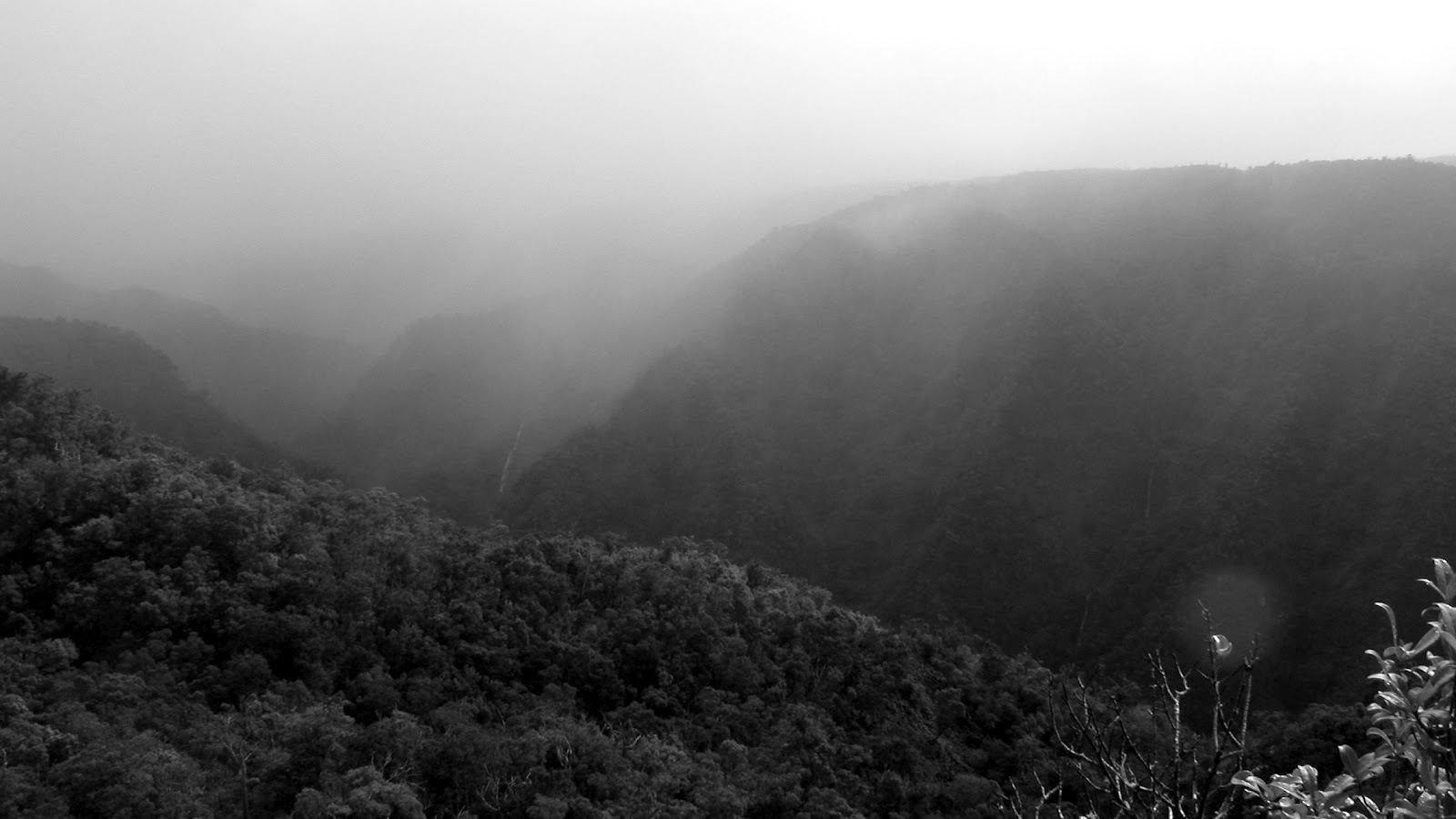

Koaie Canyon

Prior to Kauai, I had spent a while down in Guyana, South America, and my friends there turned me on to the beauty of Hennessey Hammocks.  With a built-in mosquito net and rain fly, its essentially an off-the-ground tent.  When the overnighter idea came to us on Kauai, I immediately ordered a Henessey and a super light down sleeping bag through the Garden.  Natalia was less convinced so I told her just to try a night out in my older hammock set up - a separate tarp and mosquito net and my thin tropical sleeping bag.  Hammocks are amazing in the tropics - but it gets cold on the mountain - even on Kauai.  And that night got cold and stormy.  The rain came and the wind whipped up - branches creaking and snapping - one came down so big I hollared to see if Natalia was ok.  With no insulation beneath us, our sleeping bags were essentally useless.  Well, mine worked from the top - I was sweating above, but any body part in contact with the nylon may as well have been butt naked.  But poor Natalia - I at least stayed dry - every gust sent water pouring off her tarp straight on the head.  We both pulled out space blankets for a bit more shelter, listened for falling trees, and tossed and turned and froze till morning.


the things they carried - at least for a day-trip

Daylight brought another surprise - a new river.  Enough rain had fallen on the plateau above us overnight to flood the water a good 4 feet higher than the day before.  So much for botanizing...our way out was on the other side.  We started scouting for a crossing.  It was easy to reach this giant boulder in the middle but from there it got tricky and too deep for comfort.  We half joked about being stuck out there another night - at least we were still on the high side of the stream.  In the end we decided we'd cross but played it safe - we doubled some webbing around the giant boulder and I dropped my pack, held on to the line and waded into the whitewater.  I tied the other end across the stream and went back to cross with our packs.  It was  abit exhilarating but we still had a 2,000 foot climb out.  By the time we got back to the truck we were pretty stoked on our little adventure, but ready for dry clothes and hot food.
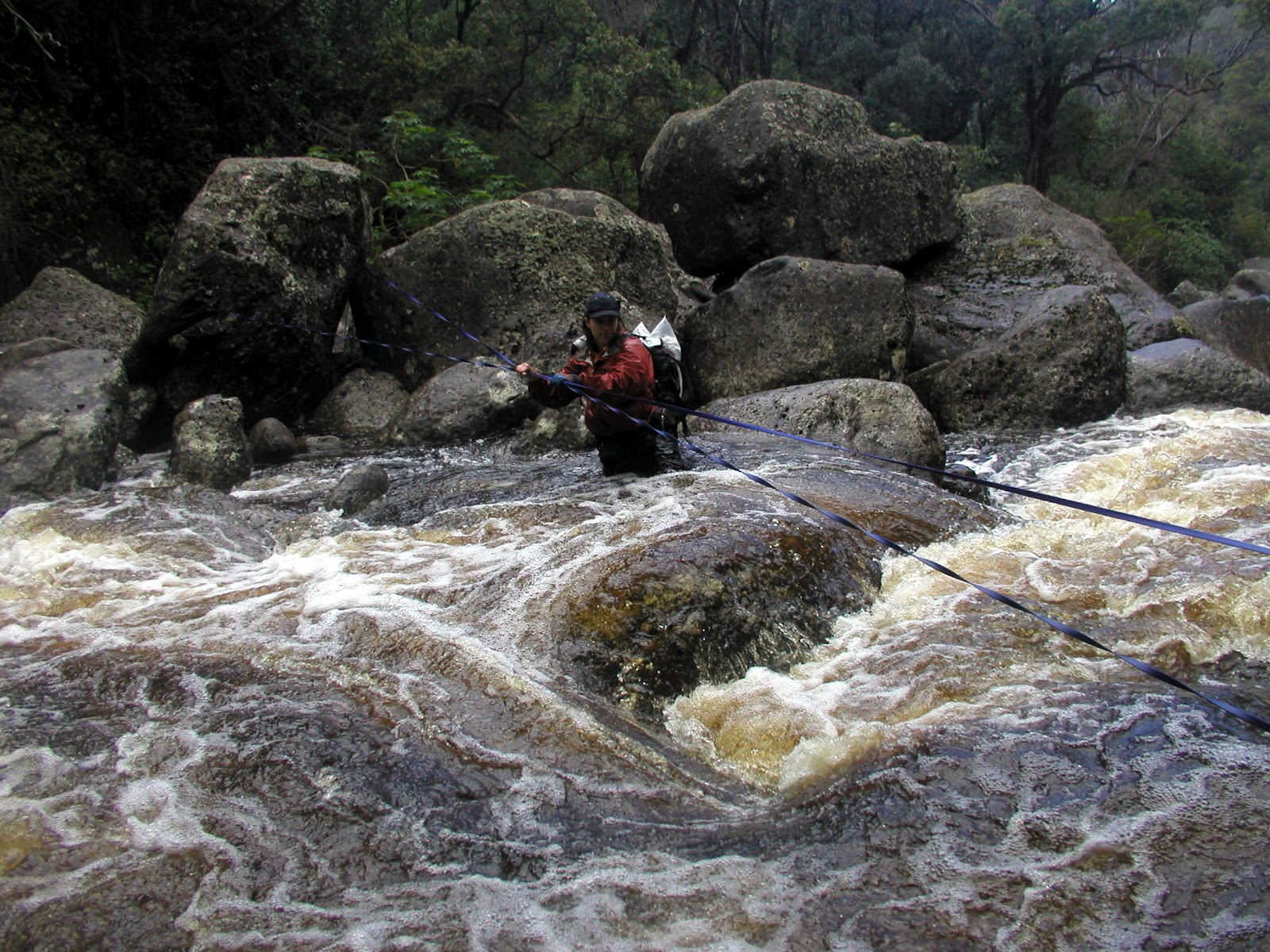

natalia goes for the crossing 

Then we came to the first crossing on the 4x4 track out.  The little stream by Sugi Grove campsite had a waste-high standing wave boiling over the cement culvert.  We took one look at it, thought about our little truck...thought about Steve getting caught in his vehicle in a flood the week before, and decided no way.  All the relief and satisfaction of the day drained out - I don't know if it was the thought of scouting another crossing, or the 6 mile walk to the payphone at the state park, but we were a bit deflated...we parked up on some high ground, thinned out the gear from our packs and started scouting again.  We actually found a cable crossing system just upstream - but of course the basket was across the river and locked.  In the end we went for the cement culvert one step at a time - after the canyon it seemed pretty mellow.  We made it to the payphone after dark.  Our supervisor, Mike Demotta, was happy to hear we were okay and drive up the mountain to take us home.


native spider - Agripore avara  - on the canyon wall

We got better.  Natalia ditched the hammock idea for a lightweight tarp setup, but I still use my Hennessey - only if I'm in the mountains, I bring a sleeping pad for insulation.  And we fell into a pretty solid routine.  Two to three nights a week we'd be out on the mountain, exploring, collecting, checking up on known locations of endangered plants, sometimes finding new ones.  We had rough days - long quiet slogs, nights stuck in crappy camp spots, also did our fair share of killing weeds - but I can't honestly think of a day out in the field I didn't enjoy.


Myrsine lanaiensis - Kolea - native and not endangered

So why did I leave?  As I'm stuck in front of the computer, neck-deep in analyses and figures and trying to write it all into a dissertation, I sometimes wonder.  I suppose I felt I could do something more.  The Garden gave me hundreds of days in the field - they've even given me field  days years later during my PhD work...Natalia got to come out with for some epic walks and veg surveys in Arnhem Land and Kakadu National Park.  Very recently I've had the opportunity to try to give something back - to try to synthesize all this fieldwork with Kauai's rare plants.  To come up with something useful not just for the Garden, but for everyone working on Kauai and potentially other islands as well.

....more to come soon.

31 October 2011

sidetracked

Schidea kaalae


...sidetracked by plants.  Settling back into life in Hawaii and while most my days are spent writing about Arnhem Land and savanna fires, there are plenty of distractions to be had here - plenty of opportunities to get back into the mountains.


the Ko'olau


Learning your plants in Hawaii is different...it is arguably the world's most eccentric flora.  This is largely a result of the islands' radical isolation from the rest of the continental land masses.  Beyond having one of the world's highest rates of species endemism, the plants here have evolved into magnificently unique forms... California tarweeds to the agave-like silverswords on the larger volcanoes, delicate violets from the Arctic gained woody stems (protection from maurauding flightless geese?), nursery bellflowers to tufted shrubs imagined by Dr. Seuss.

The plant ID skills you pick up here may be irrelevant elsewhere in the world, but there's no doubt that understanding Hawaiian botany alters one's perception of the place.  Finding native plants usually involves a good climb up the mountain, literally into a different world.  Unfortunately, very quickly along the way, one realizes that native plants are alarmingly scarce.


Cyrtandra paludosa


Its not for a lack of greenery.  Hawaii has an amazing amount of forest cover - from state and national parks to Honolulu suburbs where folks' yards back up into rain forest and dryland scrub.  Unfortunately the vast vast majority of trees, shrubs, vines, grasses - even birds - that one encounters in Hawaii's lowlands are weeds.  Released from more ecologically "aggressive" communities on the continents, these introduced species are competitively superior to native plants and have drastically transformed local ecosystems.  Compound this with introduced rats, pigs, insects, extinctions of native birds and undocumented declines of who-knows-how-many invertebrates - all disrupting the processes of pollination, seed dispersal and plant regeneration.  The result has been a dramatic and continual contraction of native forest higher up into the mountains and into smaller, more isolated patches in the lowlands.


The Oahu PEPP gals with Cyanea truncata - a species down to single digits in the wild


The description is simplistic - only because the actual system is enormously complicated - but this is the general state of Hawaiian native ecosystems.  The more gritty details just get, well, grittier.  The rarest of Hawaiian plants are so critically endangered that a state-wide program has been developed solely for their conservation.  The Plant Extinction Prevention Program's (PEPP) focus is species with wild populations numbering 50 individuals or less.  Think about that quantity for half a minute.  Then consider that on each island, there are likely 50-60+ species classified as "PEPPs".

The brighter side is that connecting with native plants and learning their story brings a lot of people to action. Organizations like PEPP, the National Tropical Botanical Garden, Army Natural Resources, the Hawaiian Association of Watershed Partnerships, the Nature Conservancy, many state agencies and more provide opportunities for folks to volunteer and even get paid to work at restoring the forests here.


 Cyanea truncata flowers - note the Drosophila fruit flies on the left - another Hawaiian species group that has radically diversified

Before heading to Tasmania, both my wife and myself had field jobs here in Hawaii.  And now that we're back, Talia's picked it right up again, working for Oahu PEPP.  So in between bouts of computer-induced madness (I am paying, one word at time, for all the fun in Arnhem Land), I get to tag along on some good walks, work out the machete on some bad weeds, and decompress in the forest.

Friends from Kualoa ranch wander down a drainage of decent native forest

Is it a losing battle?  It can be difficult to be optimistic counting plant populations in single digits.  But the conservation community here in Hawaii is growing by leaps and bounds...more energy, more ideas and more people learning, telling and changing the story.

 fortunately not everything's endangered - Peperomia oahuensis (?)


Charpentiera obovata 

 another PEPP - Schidea kaalae - tough flowers to shoot

(and happy halloween)

21 July 2008

above and beyond

Is this above and beyond the call of duty? I have spent the last week of work weeding a cliff. Not my usual job here at the Botanical Garden – more often than not I work far away from the valley in which the garden is situated. But we have a grant to support the full restoration of a cliff zone along a ridge extending into Lawai Valley, right above our greenhouse.


The cool thing about the site is that amid mostly weedy tree species – like haole koa, java plum and christmasberry – there’s a population of a threatened hawaiian plant, Schiedea spergulina. It’s a delicate little thing in the carnation family (Caryophyllaceae) that you only find growing on cliff faces on the south and western side of Kauai.


The federal government has given grants just like ours to people and organizations all over for critical habitat recovery. But most folks are failing to meet the requirements specified in their grants. So that the money isn’t lost, the agency managing the grants is revising many of these requirements. My boss recently approached me to say that now all we need to do is get rid of one exotic species - Furcraea foetida, a type of agave - along the cliff by September 30th and we can collect on the grant.


I never knew taking an arborist course would put me at a disadvantage - I imagined using the skills to collect seeds high up in the canopy…but now the task of removing all the agave from the cliff has come down to me. So I ordered myself some proper tree-climbing gear (we typically use lighter rock-climbing equipment) and got out onto the ropes.


I’ve been harnessed in on the cliff face 7 to 8 hours a day for the past week, cutting back the Furcraea with a handsaw and poisoning it with garlon. I try not to think about how much money an arborist company would charge for the same job. I go crazy enough between the cut-cut-cutting and inhaling herbicide all day.

04 May 2008

Lehua

Our field trips aren’t always into the mountains. Over the past month much of our time was occupied by two trips to Lehua, one of Hawai‘i’s offshore islets. We're headed back this week...


The last surviving pair of Lehua rabbits can no longer be found in the wild. They were put into captivity as part of conservation efforts several years ago. In fact, the same conservation effort nearly wiped out the entire population, all except the two rabbits that will spend their remaining days in a wire hutch in my supervisor’s garage. While a sad story for the animals, it’s a happy one for Lehua, because the rabbits never belonged on Lehua in the first place.

the northwest tip of the islet


Lehua is the largest offshore islet in Hawai‘i. It is the remnant of an ancient volcanic crater now standing 2 miles across and 800 feet high that has slipped halfway into the sea, forming a north-facing crescent island. Lehua lies about 1/2 mile to the north of Ni‘ihau, the last inhabited island of the Hawaiian archipelago about 25 miles west of Kaua‘i. Ni‘ihau is privately owned by a ranching family and is forbidden except for the families of the 200 or so native Hawaiians that still live there. Lehua, however, is owned by the US Coast Guard who have been allowing biologists to study the plants and seabirds on the islet for years.

nw coast of ni‘ihau

sammy the monk seal

The only native animal inhabitants of Lehua are seabirds and Hawaiian monk seals. Rabbits made their debut over a hundred years ago with the foresight of hungry sailors. They reasoned it would be nice to have some game available on the islet in case of a shipwreck. Over the years the rabbits wrought havoc on Lehua’s already sparse vegetation. Recognizing the significance of Lehua as critical habitat for nesting seabirds, the Hawai‘i State Department of Fish and Wildlife had them eradicated about 2 years ago.

hauling gear through the boobies

Although the plants have been recovering since the rabbits’ removal, Lehua is currently dominated by nonnative grasses and shrubs. This is where the National Tropical Botanical Garden has stepped in. As part of a contract with Fish and Widlife, the Garden has outplanted several hundred native Hawaiian plants. The challenge however is that plants are very thirsty when they are trying to establish and as far as Hawaiian islands go, Lehua is extremely dry. Most of the plants are on an irrigation system, so the actual watering of the plants is fairly easy. The tricky part is getting the water to the island. There’s only two options for travel to Lehua: helicopter and tour boat. Being that helicopters cost $1,000 per hour and aren’t very seabird friendly, our boss has opted for the latter.

crew off-loading water jugs onto a surfboard

The tour boat companies have actually been giving biologists rides out to Lehua for years now. There’s no proper landing at the islet, only a couple reef shelfs on the south side so you’ve got to swim in from the boat with your bags and scramble ashore. Otherwise it’s a pretty plush trip. While onboard, you get to play tourist complete with complimentary breakfast, a cruise along the Na Pali coast and whales and dolphins galore. Then after spending a couple days camping on Lehua, there’s lunch and an open bar on the way back. A couple extra mouths to feed and a little show of the biologists landing for the tourists really isn’t a big deal.

Now imagine arriving at the dock at 5:45 AM and greeting your friendly crew with over 100 gallons of water weighing close to 900 lbs, in 5 gallon jugs to load onto the boat. Those biologists suddenly aren’t so cute anymore. But they tolerate us – especially with the heavy handed tip we provide on the way there and back. We help them load and unload the jugs from belowdeck and when we arrive at Lehua a crewmember uses a longboard to swim about 3 jugs at a time from the boat to shore. Its definitely a production but once on island, as I said, its pretty mellow. We use a portable 4 hp water pump to move the water from the shore up into the irrigation tank and aside from a few plants off the system it pretty much takes care of itself.

ridiculous red-footed booby

Exploring the island is fairly amazing, especially now during the seabird breeding season. The first sight to greet you are hundreds of red-footed boobies nesting in the shrubs and squawking in irritation as you pass. The slopes of the crater are also littered with the burrows of wedge-tailed shearwaters which makes walking anywhere on Lehua sometimes feel like a surgical procedure. Further upslope brown boobies nest on the ground and larger burrows are often occupied by red-tailed tropic birds. Over the ridge on the northern slope, the inner side of the crescent, are black-footed and laysan albatrosses cruising the tradewinds like small aircraft and already nursing chicks this time of year.

Back on the south side is base camp – a weatherport with cots and gas stove. The north shore of Ni‘ihau entices you from across the channel to the south with miles of empty, beautiful white sand beaches. And the humpback whales are all but gone now, migrating back towards the Arctic. But during both our Lehua trips in March and April, juveniles and mothers with their calves constantly cruised and breached all around the island.

base camp

condos for wedge-tailed shearwaters

Our first trip over Easter weekend consisted mainly of weeding, watering, and setting rat traps around the native plants. We also explored the Northwest crescent arm, collecting native plant seeds from the only area the rabbits didn’t reach. On our second trip just two weeks ago, Brenda Zahn, a bird biologist on Kaua‘i, accompanied us and we helped her band albatrosses and red-tailed tropicbirds. Pretty darn cute, those albatross chicks - especially when they start barfing fish oil all over you when you grab them for banding. Its gross and the poor guys are losing the lunch for which their parents have been scouring the seas all day. But the benefits outweigh hungry chicks and stinky field clothes - bird banding enables concrete measurements of breeding success and survival of threatened seabirds like the albatrosses nesting here.

a young whipper-snapper

Conservation efforts on Lehua – the banding, the revegetation, the rabbit removal – they’re all for the birds really. Albatross are hit hard by long-line fishing. Both they and the red-footed boobies nest in only three places on the main Hawaiian islands, and Lehua is the only place where they don’t have to contend with dogs and feral cats. Now that the Lehua rabbits are gone, slated next for eradication are the rats, known predators of seabird eggs. While few could argue against planting native vegetation, killing introduced animals is certainly more controversial, certainly the darker side of conservation.

Natalia and Brenda band another one

On the first day of the our most recent trip, we contour along the southern slope of the crater with Brenda to visit a colony of nesting cattle egrets in a kiawe tree. Another modern introduction to the Hawaiian Islands, egrets are also known predators of seabird chicks. Natalia and I came here on our last trip and threw the eggs to the fishes, but didn’t have the heart to do the same with the recently hatched chicks. With years of intimate work with her seabirds, Brenda has no qualms. The helpless chicks from three weeks ago are now running from us on two strong legs. I grab my first one and feel its heart beating in my palm.
“Cervical dislocation,” Brenda yells over to me as she demonstrates by yanking the head and neck of the egret chick in her hands. “This is brutal,” I say to myself.
I take another look at the red-foots nesting in the same tree as the egret colony. I’m here to help, right? Brenda’s onto her third victim already. Before a second thought arises, I yank the egret’s head. The beating heart stops and I throw the body to the sea. Plenty more chicks are scrambling through the kiawe bush. No rabbits, but more dirty work yet to be done.

black-footed albatross and landing gear

waiting for food
sammy's portrait shot