
"I pick fruit."
I did pick lots of fruit. Collecting seed from native Hawaiian plants was one of the main responsibilities. The Garden grows plants for projects attempting to restore native habitat all over Kauai and elsewhere in Hawaii. Natalia Tangalin - who is still living the Field Botanist dream job - got stuck showing me the ropes. We started with day trips (actually we started surveying weeds along the roadside in an old Ford Explorer with a leaky exhaust system - but that's another story) - collecting mostly up in the forest in Kokee state park or in the native coastal plant communities on the south shore and east side of the island. But we soon began to dream of the Garden's hay days - back in the 80s and 90s when helicopter budgets were flush, before Hurricane Iniki leveled half of Kauai's native forest - when our colleagues and predecessor Field Botanists Steve Perlman and Ken Wood were getting dropped into the most remote parts of the island, finding new species, making the cover of National Geographic… Man, they got it good.
 |
Yes - this is a National Geographic cover - plant in the mouth - nice touch Kenny!
|

wet road in Kokee and my favorite Garden ride
Our first real 'shake-down' was hilarious in retrospect. In reality it was cold and wet wet wet - scary wet. Winter time on Kauai and just the week before Steve got caught in a flash flood, yet another story but for someone else to tell. As far as we were concerned we were playing it safe. We took the Garden's Toyota pickup through Kokee State Park, past a couple little stream crossings to the end of Camp 10 road. After a relatively short walk along the north rim of Koaie Canyon, Natalia found this hunter track she'd heard about and, with full packs, we dropped off the edge of the Alakai Plateau. Less than a half mile long, the track dropped over 2,000 feet (about 600 m) - a radical shortcut that left us far in the back of the canyon. Its a very cool vegetation zone - a high diversity of native plants due to the intermingling of the rainforest of the Alakai wilderness with the drier forest of Waimea Canyon - and home to a few scattered individuals of Alectryon macrococcus (Mahoe), a small Hawaiian tree that's critically endangered.

natalia films the decent
We set up camp across the river and explored downstream into the drier forest zone. As the wet forest elements thinned along the banks, we poked into a couple smaller tributaries leading up to waterfalls below the occasional giant white hibiscus tree. Looking west you could see the 'new' forest of invasive strawberry guavas marching up the sunnier, drier slopes of the canyon, while east towards the back, the darker, patchier canopy of native ohia-lehua trees held on. No Aletryons that day. We made it back to camp a bit before dusk and checked out our setup.
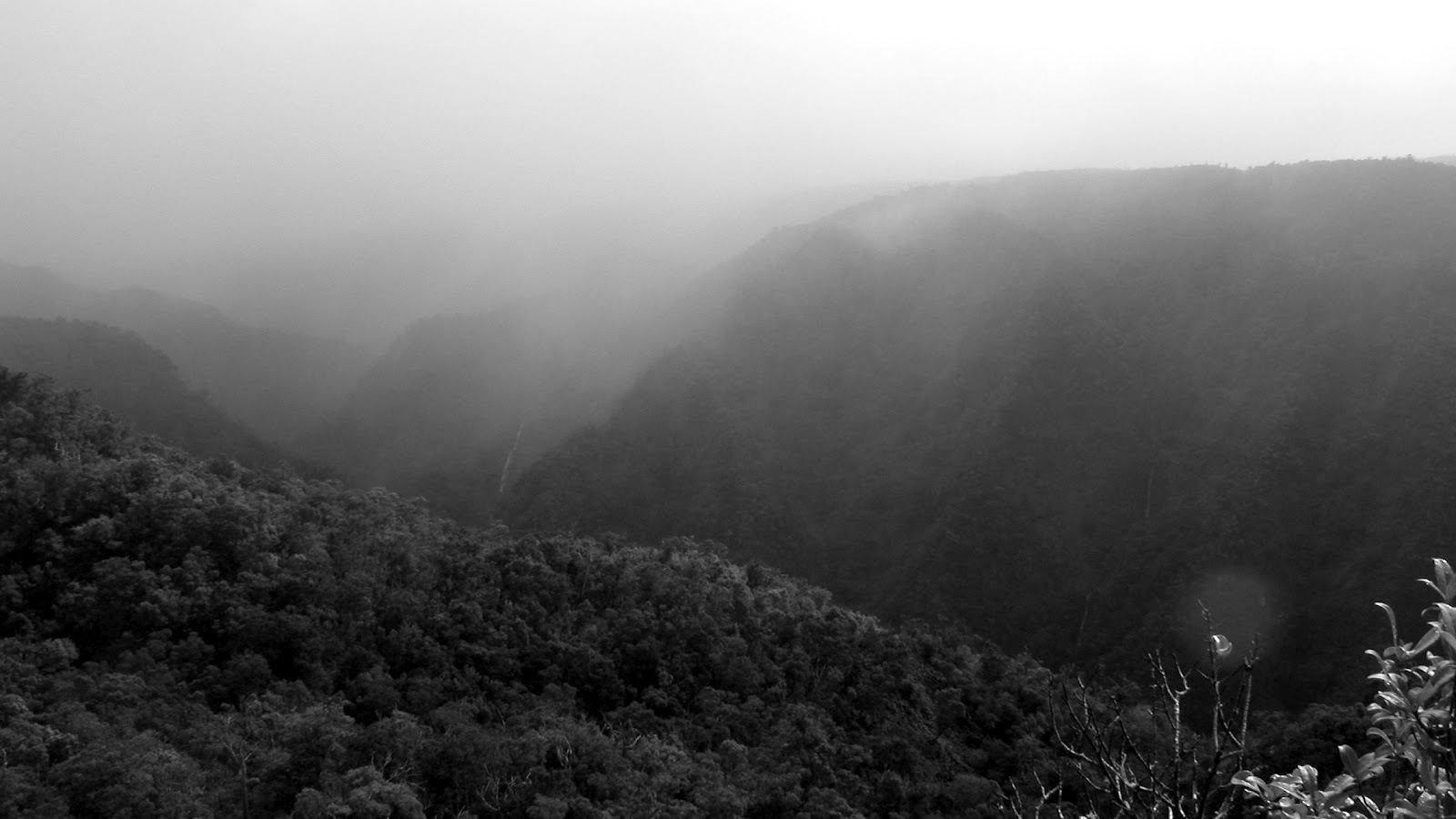
Koaie Canyon
Prior to Kauai, I had spent a while down in Guyana, South America, and my friends there turned me on to the beauty of Hennessey Hammocks. With a built-in mosquito net and rain fly, its essentially an off-the-ground tent. When the overnighter idea came to us on Kauai, I immediately ordered a Henessey and a super light down sleeping bag through the Garden. Natalia was less convinced so I told her just to try a night out in my older hammock set up - a separate tarp and mosquito net and my thin tropical sleeping bag. Hammocks are amazing in the tropics - but it gets cold on the mountain - even on Kauai. And that night got cold and stormy. The rain came and the wind whipped up - branches creaking and snapping - one came down so big I hollared to see if Natalia was ok. With no insulation beneath us, our sleeping bags were essentally useless. Well, mine worked from the top - I was sweating above, but any body part in contact with the nylon may as well have been butt naked. But poor Natalia - I at least stayed dry - every gust sent water pouring off her tarp straight on the head. We both pulled out space blankets for a bit more shelter, listened for falling trees, and tossed and turned and froze till morning.

the things they carried - at least for a day-trip
Daylight brought another surprise - a new river. Enough rain had fallen on the plateau above us overnight to flood the water a good 4 feet higher than the day before. So much for botanizing...our way out was on the other side. We started scouting for a crossing. It was easy to reach this giant boulder in the middle but from there it got tricky and too deep for comfort. We half joked about being stuck out there another night - at least we were still on the high side of the stream. In the end we decided we'd cross but played it safe - we doubled some webbing around the giant boulder and I dropped my pack, held on to the line and waded into the whitewater. I tied the other end across the stream and went back to cross with our packs. It was abit exhilarating but we still had a 2,000 foot climb out. By the time we got back to the truck we were pretty stoked on our little adventure, but ready for dry clothes and hot food.
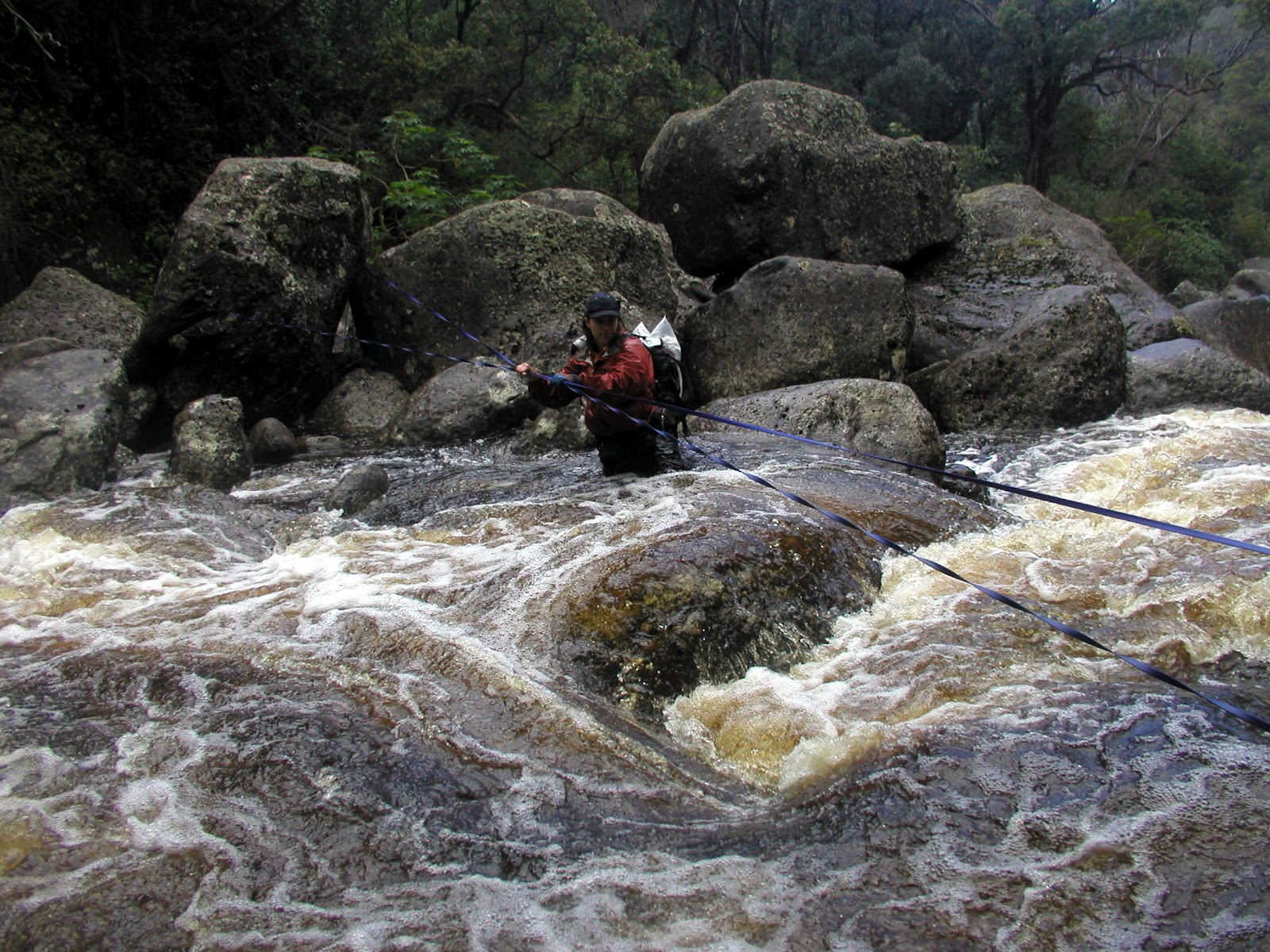
natalia goes for the crossing
Then we came to the first crossing on the 4x4 track out. The little stream by Sugi Grove campsite had a waste-high standing wave boiling over the cement culvert. We took one look at it, thought about our little truck...thought about Steve getting caught in his vehicle in a flood the week before, and decided no way. All the relief and satisfaction of the day drained out - I don't know if it was the thought of scouting another crossing, or the 6 mile walk to the payphone at the state park, but we were a bit deflated...we parked up on some high ground, thinned out the gear from our packs and started scouting again. We actually found a cable crossing system just upstream - but of course the basket was across the river and locked. In the end we went for the cement culvert one step at a time - after the canyon it seemed pretty mellow. We made it to the payphone after dark. Our supervisor, Mike Demotta, was happy to hear we were okay and drive up the mountain to take us home.

native spider - Agripore avara - on the canyon wall
We got better. Natalia ditched the hammock idea for a lightweight tarp setup, but I still use my Hennessey - only if I'm in the mountains, I bring a sleeping pad for insulation. And we fell into a pretty solid routine. Two to three nights a week we'd be out on the mountain, exploring, collecting, checking up on known locations of endangered plants, sometimes finding new ones. We had rough days - long quiet slogs, nights stuck in crappy camp spots, also did our fair share of killing weeds - but I can't honestly think of a day out in the field I didn't enjoy.

Myrsine lanaiensis - Kolea - native and not endangered
So why did I leave? As I'm stuck in front of the computer, neck-deep in analyses and figures and trying to write it all into a dissertation, I sometimes wonder. I suppose I felt I could do something more. The Garden gave me hundreds of days in the field - they've even given me field days years later during my PhD work...Natalia got to come out with for some epic walks and veg surveys in Arnhem Land and Kakadu National Park. Very recently I've had the opportunity to try to give something back - to try to synthesize all this fieldwork with Kauai's rare plants. To come up with something useful not just for the Garden, but for everyone working on Kauai and potentially other islands as well.
....more to come soon.


