Showing posts with label Arnhem Land. Show all posts

23 April 2012

the literature

Got my the first publication from my phd out a few weeks back.  Makes me feel like things are happening, even with all this time OUT of the field, clicking away at a keyboard.

http://onlinelibrary.wiley.com/doi/10.1111/j.1365-2745.2012.01970.x/abstract

At any rate - its not super gonzo, I'll admit...journal articles are more like the slick, trimmed down, fat-free, finished product after all the fun stuff.  Very important in terms of contributing to the scientific literature, and eventually to management, however, these publications rarely make to the general public.  There's a reason - they're dry, hardly any story at all.  As in this instance - there's no part about Talia and I getting dropped off on Balang's and Bilinydjan's country in Arnhem Land with a trailer full of food and a satellite phone for 2 months.  Nothing about cooking over an open fire every day, carving hunks of meat of wild buffalo legs, and playing the dreamtime songs Balang put his father's and grandfather's stories to.  You definitely can't write about steaming fish in paperbark, or the dingos howling across the river, or the water python that came up to us, as Bilinydjan said, take Talia's sickness away.  Even the fires we lit with them - wrapping our whitefella (or yellowfella as they called Talia), foreign heads around the fact that here in Arnhem Land, people burn country - even those were relegated to a few technical lines in the methods section..."fires were lit in as an arc of patch fires c. 25 m upwind from the start of each transect..."

Not to say, by any means, that scientific publications are UN-important.  After all, the questions we go after in these papers are an exciting part of ecology...in the case of this paper the factors driving heterogeneity and diversity in these savannas, and ultimately, a better clue to understanding people's role in the system.  But the streamlining and competition for publication among the scientific literature leaves little room for the "chaff" above.  Thankfully I've got this web-page to share the fun stuff.


>>>UPDATE>>>>>

The journal NATURE apparently liked my research too...maybe we should've submitted it to them (its one of the highest ranking scientific publications out there in terms of readership and citations)

http://www.nature.com/nature/journal/v484/n7395/full/484418a.html

17 October 2011

tucker truck update


a very cool skype call the other day.  typed some numbers into a laptop in the back of manoa valley and a little phone booth in the middle of the arnhem land savannas rang away.  let it ring a few times to get someone's attention then hang up.  give them time to wander over to the booth, and call again.  this time, Bilanjan picked up in the little community of Kolorrbidahdah.  we talked story with her and Balang, Wamudjan and Wamud for over an hour and everyone's healthy and happy - the tucker truck is back in action.  

24 August 2011

the tucker truck


Starving time.  Unfortunately, I didn't write down their word for it.

Spent a few nights at Yaiminyi just last month, an old outstation nestled between a little creek and some stone country outcrops at the eastern edge of the Arnhem Plateau.  The first day there, the two of us balanda (whitefellas) went gatum (up river) to count trees as diligent botanists do.  Balang and family walked gandji (down river) for the day, doing manwurrk (burning country) and hunting gomdow (long-neck turtles).  By the time we returned to camp, they had already roasted two gomdow on the coals for lunch, two more were kicking around in an old flour tin next the campfire.


"Garreimun gomdow molam?" ('We eat turtle tomorrow?'  Bits and pieces of language were coming back to me from the year before.)

"Maybe, but maybe we save them for when starving time comes."

And I crack a joke: "You mean till the Tucker Truck comes next week?"

"Nah, no more Tucker Truck." 

"No more Tucker Truck?  Since when?"

"Since…maybe after you and Talia left in the dry season - last year."  No joke.

The Tucker Truck has been servicing central Arnhem Land for over 30 years - every dry season and as long as roads stay open through the wet.  For families at outstations, its their lifeline to the goods and services of town - especially in communities like Kolorbidahdah where no one has a working vehicle.  Every two weeks, the Tucker Truck rumbles out of the government settlement of Maningrida on the coast and makes rounds to the 30 or so remote outstations serviced by the Bawinanga Aboriginal Corporation (B.A.C.).  Flour, sugar, tea bag, milk powder, tin meat, and baki (tobacco) are the local staples.  It also provides other necessities like lighters, flashlight batteries, and fish hooks and line.


Or rather, provided them.  The program manager for the Tucker Truck stepped down last August and Bawinganga has yet to resume the program.  What this means is starving time - an old, old word with an unfortunate new resonance.  Balang and Bulanyjan had told us about a couple harrowing, hungry weeks during the wet season – a 20 km walk with their 6 and 3 year old to a neighboring outstation for food, the B.A.C. Rangers bringing in supplies another time by helicopter.  Yet we simply assumed the Tucker Truck couldn't reach the outstation because of flooded roads.  Instead, over the past year Balang and his extended family at Kolorbidahdah have been relying on "bush tucker" – fishing, hunting and gathering food from the rivers, billabongs and savannas surrouning their home – as well as the occasional lift to town from the Rangers and family from other outstations.  But being one of the furthest communities out and at the end of the road, life in Kolorbidahdah has fallen on tough times.


In central Arnhem Land, the outstation "movement" began around the late 1970s in order to give Aboriginal people the opportunity to leave the government and missionary settlements like Maningrida and move back to managing and living on "country" they've come from.  And the very cool part is that it is their country – Arnhem Land has been officially recognized as Aboriginal territory for decades.  In order to fund the whole enterprise, the Australian federal government established the Community Development and Employment Program (CDEP).  The CDEP is essentially an alternative form of government assistance, wherein Aborigines are provided housing and a living stipend for managing their lands at the outstations.  The whole program is highly controversial among whitefella Australians.  To many, the CDEP is simply living "on the dole," (though payments amount to less than welfare) and they question the use of tax money to resource tiny and remote communities.


The alternative argument, however, makes both economic and humanitarian sense.  Bininj (Aboriginal people) highly value their relationship with country and those who choose to live on outstations generally retain healthier and happier lifestyles.  Fishing, hunting, making didjeridus and other other traditional crafts, and all the stories which connect living and ancestral bininj to the land...these things are too often lost when people leave their country. And for bininj who settle in larger towns the social and physical woes of alcoholism, drug addiction, domestic violence, and preventable diseases such as diabetes are appallingly higher than for the average Australian balanda (whitefella).


Balang and his family are incredibly resourceful – the diversity of foods that bininj exploit is mind-boggling.  And with no Tucker Truck some "long time, old time" methods of food production have gotten a cultural dusting off.  They showed me photos (taken with their mobile phone of course) of a huge fish trap they built across the river during the wet season – something Balang hadn't done since he and his brother were kids living out on remote country with their father, far from the Tucker Truck.  They had also begun revisiting old yam beds that haven’t been managed for years.  Although bininj are technically considered never to have practiced agriculture, garbara (yams) are a staple resource that was carefully managed through weeding, transplanting, and protection from fires.  Very cool, but also very easy to view this knowledge and resourcefulness through a lens of nostalgia and romance…the danger is not realizing the suffering the comes hand in hand with such a dependency.

To have the choice and option of bush tucker is a cherished part of life in Arnhem Land.  But to expect bininj to live off the land like the folks of "long time, old time"  is unrealistic and fundamentally inhuman.   If the Tucker Truck fails to resume, it is inevitable that Balang and his family will move to Maningrida.  Kodjan, Balang's mother has already left Kolorbidahdah.  They don't want to.  Balang's grandfather took his family there in the 1950's – a three day walk from their country far to the south.  After two days in town he decided marek (nope).  He turned around and marched the whole family back home – where he felt they belonged.  That decided Balang's lifestyle.  He grew up hunting wallabies with mangole (throwing spears) up in gobahbat (stone country) and hearing his grandfather's and father's stories…incredible, but again, a dangerously romantic and nostalgic.  It was a day's walk, but throughout Balang's childhood, even they had dry season access to the Tucker Truck. 

There was rumor in Maningrida that Bawinanga might start the bugger back up soon…never thought I'd put so much hope into the bloody Tucker Truck!


28 July 2011

Stone Country Dimensions 2

Macrocosmos...

the stone country is a universe unto itself.  seasonal, eternal, and as expansive as your imagination.  

yet as wide and wild as this landscape seems, the human footprint (and handprints and more) is everywhere, and has been everywhere, for longer than history can fathom.


07 December 2010

Manwurrk


For a Balanda like me, a whitefella from the far far northeast - burning country (manwurrk) with Aboriginal landowners was certainly something out of my sphere. I went to Arnhem land with a research plan in place and that plan depended on having Traditional Owners, our friends at Dukladjarranj, help us light savanna fires. The question at hand is whether and how these cool fire-sensitive conifers - manlarru or Northern Cypress (Callitris intratropica) - can actually suppress these fires. (turns out they do....quite an amazing ability for a plant if you think about it).


In tropical savannas all over the world, it is rare for any given patch in the landscape to go for more than a year or two without getting burnt. And in northern Australia, people have been setting those fires for more than 50,000 yrs. For Balang and his countrymen in Arnhem Land, fire really is nothing - burning country is just what you do when you're in the right place at the right time. Wamud, 2 yrs old, learned to strike matches and lighters before our eyes. His mother Bulahnjan would show him a decent clump of grass and he'd work his little fingers on the flint till he set it ablaze.


It goes without saying I had a lot of catching up to do. Fire here is just part of the landscape, the ecology, and the culture. Despite how well I know this, understand this, study this, there was such an overpowering sensation of nervous energy - anxiousness, even trepidation - when it came to letting those crackling matches sail from my own finger tips into the grass.

Then of course there's another side - the pyromaniacal 5-yr-old residing in us all (though still way behind Wamud). Fire exerts such an instinctual and emotive force on our psyche. All mixed up with the sensation of absolute irresponsibility, chucking matches left and right, was childlike delight in mayhem.


Understand though, this was far from chaotic arson in the bush. With Balang's guidance we were setting our fires to target the transects we had set up through stands of Cypress. Of course what the fires did past the study site was beyond our control. I will say we were playing quite conservatively. It was relatively early in the dry season after late rains, meaning fairly wet grass, and the local Djelk rangers had already lit fires along the jeep track about a kilometer downwind...leaving extremely limited potential for disaster.


But after the 4th fire we lit, I almost vowed to stop. It was a fairly unspectacular burn. We waited a bit too late in the day and the trade winds were all but dead. We lit the fires with Balang and Bulahnjan and the bloody thing was taking so long to reach our study transects, they decided to walk home. Eventually the site burnt and we got the data we wanted. With the sun filtering magically through the smoky evening, we walked home too.

Two days later, I returned to check out the scene of the crime and scope out the next spot we wanted to burn. After finding a couple decent patches of unburnt Cypress nearby, I traversed North to look for more. After about half a kilometer, the thigh-high bunch grass gave way to a fresh burn. And relative to the little patches we had lit up so far, this burn was bigger, much bigger. As I gazed to the north and west, taking in its full extent...then followed its lines back eastward, behind and upwind from where I had just come, my heart sank. This was my fire. How else could it have burned? The back burn. Fires are certainly driven by the wind, but they can also creep upwind from the ignition point and sneak around the place in all sorts of devious ways.

Shit...this was way bigger than I had intended. My rational brain fought to keep things in perspective. All in all, it was probably less than a square kilometer in size - still very small by Northern Territory standards. But these thoughts fought hard against my emotional reaction - the weight of realized culpability and consequence. The freshly burnt country ran all the way west to the jeep track and stretched long and wide to the north where some low rocky country probably (hopefully) caused it to peter out.

No more burning, I said to myself.

What a silly thing - how unaccustomed was I to being part of this force that's so commonplace in Arnhem Land? More rationalization ensued. Its just a speck (and really it was), as I continued walking through the low charred stems and ash. It would have burned anyway (but then not by my hand). Nope. No more burning. And so on went the inner dialogue all the way back to camp...

A silly thing indeed - a very Balanda reaction - I've wrought such destruction! How melodramatic. This little fire seemed so huge to me there on the ground. And yet I knew the whole time that in the grand scheme of this landscape, my fire really was nothing. We burned again - three more sites. And after all was said and done, you know what? I went back and tracked the back edge of that 4th fire - the one I thought got away - and it didn't connect. That big patch burn wasn't even mine - it was burned from helicopter by the local Aboriginal Ranger crew. What did I tell myself? It would have burned anyway.


And now its months later back in Tasmania...I'm armpits deep in data analyses (thinking thinking thinking about our amazing friends the Cypress trees) and about to tuck into some serious writing. But to really write about fire I wanted first to remember living with fire - as if I'm afraid to re-acclimatize to the predictability and control of our "modern" life. So I get to relive my own little coming of age with burning country, experiencing savanna ecology live. And my heart still jumps at the thought of those fires, drifting and flaring through the grass. Ironically, the utter beauty of burning country - its wildness and unpredictability - belies the fact that it may ultimately have left the mark of humanity upon an entire ecosystem.

But all abstract reasoning and philosophical waxing aside, fire is a beautiful thing.


**photos taken with a Pentax k10

13 October 2010

Mago Monster

The austral winter has already given way to the hot season in Central Arnhem Land. Its been weeks since we left and I’m left haunted again by the beauty of this place and its people. As I slip back into the crankpot drudgery of datasets and computer models, it begins to feel like a dream - 6 weeks in Arnhem Land...cast off from the world of mortals with a satellite phone and a trailer full of food. Magic magic magic.

Music was our entry card. As a gift, we gave our host Balang an acoustic guitar, knowing he played, but not knowing that his own instrument had been broken for a while. For five days straight, no joke, from morning till past our bedtime he strummed that guitar like the Mad Minstrel of the Bush. It is difficult to comprehend, much less describe, the cultural gap between whitefellas and blackfellas in Australia, but as it is written: music is love. Balang’s guitar and my little beat up old mandolin rang into many a night out there in Arnhem Land. And from so many early awkward moments, it helped our family and their family find harmony.

With the juxtaposition of such European instruments in such an un-European place, questions about instruments from Balang’s country were inevitable. Maybe the most iconic, the didjeridu, is not native to all Australia - it comes from Arnhem Land. What began as very simple conversation - a bit of practice in Kune, one of Balang’s languages - inadvertently led to a little adventure.

Balang: ‘Mago, its called. The didjeridu is mago.’

And me, like a child: ‘Ah...mago...’

‘Ngai djarre mago!’ (I like didjeridu)

‘Ngai djarre marnbun mago!’ (I wanna make didjeridu)

‘Molam garrire garinan mago?’ (tomorrow we go and see didjeridu?)

And so forth in my broken Kune, night after night, joking by the fire, plucking our instruments.

Until one day Balang says ‘Gamak, garrire molam.’ (Good, let’s go tomorrow).

Next day I come in from a morning of fieldwork to find a note from Talia, “we went across the river for mago!!!”

Crap - I’m not missing this. So I go after them, cross the river up into proper stone country, following footprints in the sand.


Up by a little creek the track faded. I give a “hui!” and there they are, Talia, Bulanjan, Wamudjan and Wamud, up across the stream hunched over a tree stump.

‘Mangun!’ Sugarbag. The little hives of the beautifully stingless Trigona bees colonize old trees, rock crevices, sometimes straight in the ground.
Get a digging stick and yank a hunk of comb straight from earth to mouth...glorious honey streaming down your hands.
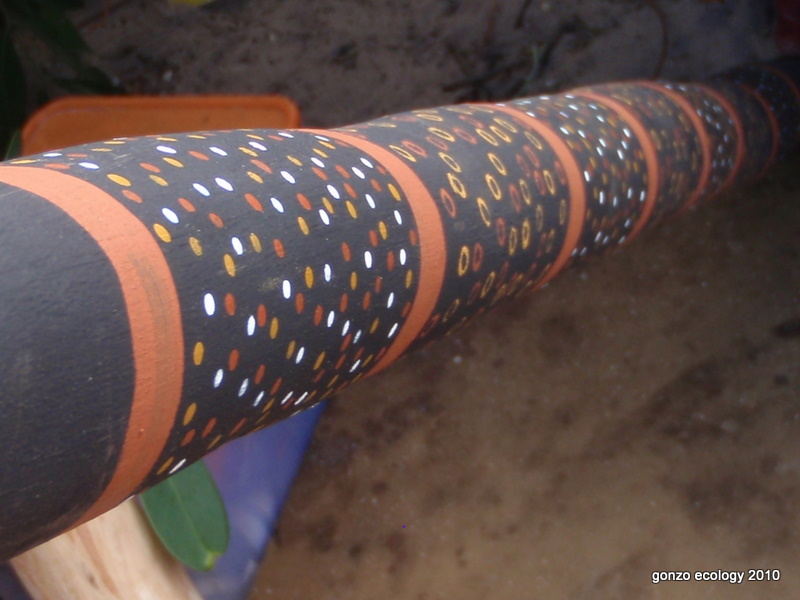
The wax is saved for the mago mouthpiece.


Not too far off, Balang knocks on young Eucalyptus trees (E. miniata and E. tetrodonta), listening for hollow notes. Tree-piping termites (Coptotermes) do most of the work by eating through the center of the stems, but harvesting is only the first step from tree trunk to mago.


The monster mago project has begun. We first talked about mago in the singular. Now we’re hauling eight stems back to our home at Dukladjarranj.


Back at camp, the bark is peeled with a knife, then a rasping file burnishes the mago clean.


Sandpaper preps the surface for painting...ah the paints. Balang and Bulanjan spend days and nights painting in layers...strictly from the earth - charcoal for black, grinding red and yellow rocks from the stone country itself.


Delek, the white clay, requires more work. Veins of the sediment are spotted in the rock, often near, sometimes even in the river. By our camp, another Balang and Wamud pull out delek bit by bit with a rebar hook.


Pigments are mixed with a bit of water and some wood glue to adhere to the mago. A stem from a river sedge makes a good paintbrush, and the designs come from dreamtime stories and imaginations of Balang and Bulanjan.


Couple days later, Balang goes back for more stems. More prepwork and all-night painting sessions.

Ten days later, they’re finished. We roll the mago into a swag and they’re ready to haul to Maningrida, 70 km north on the coast. Why take them away? Along with music, there’s a fair bit of money to made with these mago. In Maningrida, the aboriginal art center accessions his work, cuts him a nice check and later that day, Balang’s back at Dukladjarranj and his ‘didjeridus’ are on their way to Darwin for an art expo. That’s another story altogether...


Bulanjan pulls out a honeycomb
Balang mixing paint

03 June 2010

The Wet

As northern Australia comes into the dry season, I'm looking ahead to a solid month or so of fieldwork in Arnhem Land. This is where my own adventure began in Australia a year ago and it will be good to get back out into the savannas around the outstation at Korlobirrahda. But there have been adventures in between as well. And as I prepare for the predictable sunny days and relatively cool weather which prevails this time of year, its good to remind oneself – and share with everyone else – that there are two worlds at play in Australia's Top End. You see, like hot and cold, light and heavy, silly and serious, you cannot have the dry without The Wet...

dry season (above) to wet season (below)

The Wet is what the monsoon season has come to be known in northern Australia. Ever since the rise of the Himalaya 30 million years ago, the Asian monsoon descends upon the savanna woodlands and tropical forests each year with a steady cycle of storms – dumping 90% of the annual rainfall between the months of December and April. On the Arnhem Land Plateau dry creek beds and trickles of water along the famous Escarpment become raging rivers and waterfalls. After the long dry season, plants can once again transpire and photosynthesize stress free – and they flourish. In the lowlands rivers and wetlands swell and flood, fish and crocodiles follow the waters, dispersing far and wide across the landscape. Other animals flee for high ground, often trapped on islands and even tree-tops during severe floods.


Humas usually flee too – under roofs and into air conditioning. As far as fieldwork is concerned, the vast majority of scientists (the sane) save it for the dry season. Ahhh... predictable, sunny, non-sweltering dry season. It makes sense. In the wet, roads get closed, vehicles get stuck, streams get uncrossable, and its hot, humid, and stormy. But its also incredibly beautiful and alive...so when my supervisor suggested a wet season trip up into the Stone Country on the Arnhem Plateau in January, I needed very little convincing.


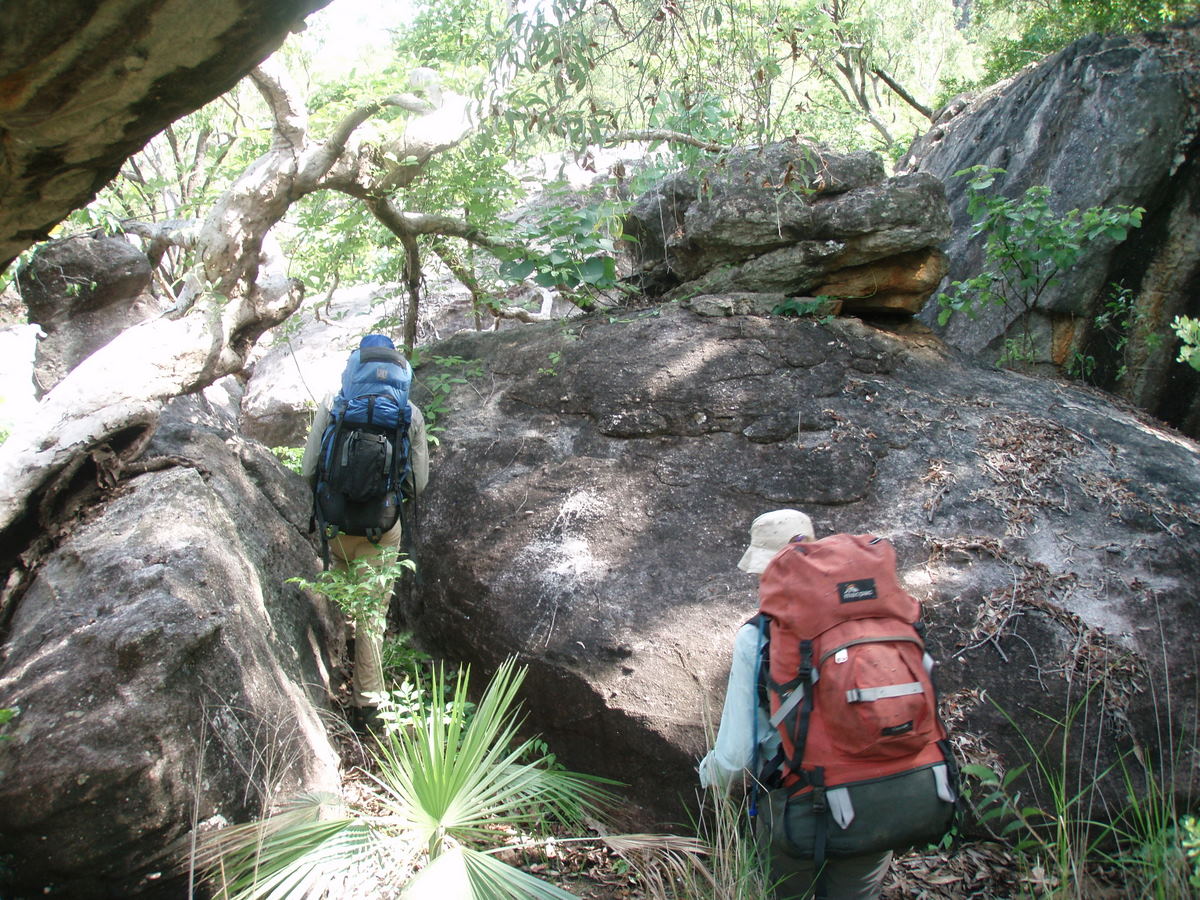
Needless to say, the “expedition” was mindblowing. I took a couple friends (whom I cannot thank enough for helping me out) on two 6 day walks in some good Cypress Pine country in some of the more remote sections of Kakadu National Park (for more on the Cypress Pine story check here.) Aside from the logistic costs of wet season field operations – yes we got dropped in by helicopter, it was incredible – the field conditions weren't really all that bad. It rained, we got wet. The sun shown, we dried out – and got hot – and basically hoped it would rain again...which it inevitably did.


But to see the Stone Country savannas sweeping away all flush and swathed in greens, to watch the monsoon storms come ripping over the sandstone outcrops and blacken the sky, to catch a flash of dark fur as another walaroo (an endemic wallaby species) bounded from beneath a rock shelter, to feel the quenching relief of the rain, washing the sweat out of our field clothes once again...these are just an inkling of the many moments that instill the Wet with a mythic and magical quality.


Well with that, I'll let the photos tell the rest. And how about this: You too can enjoy a wet season trip in the Australian tropics – my friend Russell who came with us on the first 6 day walk runs the best guiding company in the business out of Darwin...some of the trips he runs make my little bit of fieldwork here seem like a walk through the garden veranda at the Holiday Inn. Check out Willis' Walkabouts.


the drive through the lowlands with Russell and Zoe


Zoe was a bit jealous of my setup


plant hopper


I didn't mention the flies, did I...

death adder


Petraeomyrtus punicea

another storm approaches


Jim Jim Falls in flood


Brett and Zoe waiting for supper
Stone Country


Allosyncarpia tree in a rain forest patch


Callitrix megacalyx (I believe)

water water everywhere

bower bird nest